Boulder Cello Project
  • Home
    • News
    • Music & Health >
      • Music & the Mind
      • Power of Music
  • About Us
    • Play-in Moderators
    • Composers
    • Reviews
    • Partners >
      • Music Sponsors
      • BCP Friends
  • Play-in
    • Videos
    • Photo Album
  • Concerts
    • Chase Concert for Kati
    • Chase Concert for Chito
  • MEMBER LOGINS
    • Membership
    • Annual Membership Fee
  • Links
    • Member's sites
    • Orchestras & Ensembles
    • Cello Societies, Workshops & Festivals
    • Cello Music Sheets
    • Cello Links Online
  • Contact Us
    • Thank you!
  • Music Download November 7 2014

Next Scheduled Play-in

Our next scheduled play-in is: Sunday August 20th @ 1pm

Please visit our Meetup.com site for more details, including our Boulder location.  We will try to rotate between weekends and weekdays to allow members to find a date and time to participate.
Picture


What to Expect in a Play-in?

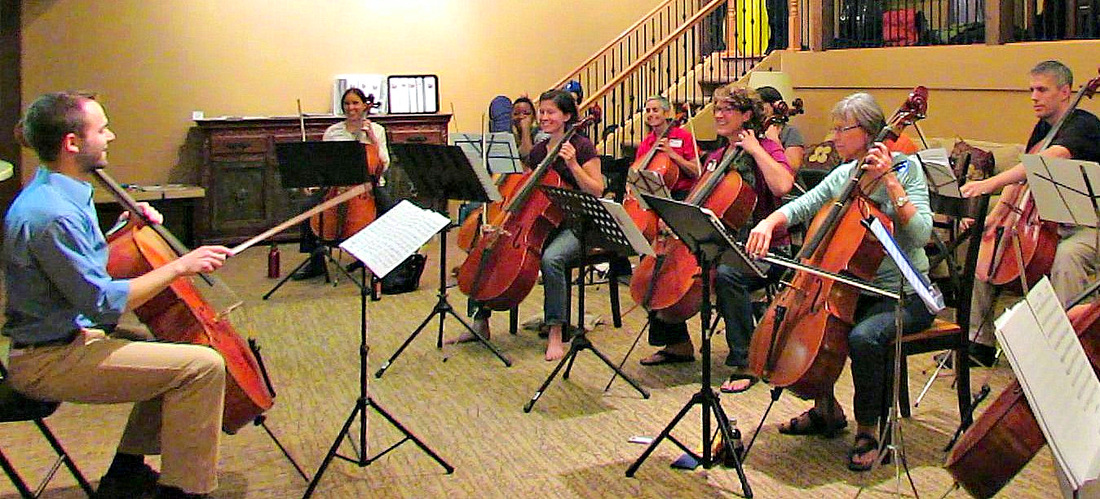
Learning to play the cello is a fun and rewarding experience in and of itself. We all started with lessons (group or individual) and lots of practice at home by ourselves. But, we cellists really are social animals; we need to play with others. Playing the cello with others takes the musical experience to an entirely richer level.


What is a "Play-in"?
We call our gatherings to play cello ensemble music: “Play-ins”

Benefits of a Play-In :
1. Learn to play with a smaller ensemble with and without a conductor;
2. Practice sight-reading; and
3. Experience the pleasure of playing cello choir music.

A play-in is not a group lesson on individual cello technique. It is an ensemble experience led by a group leader - what we like to call "moderators." On occasion, we will bring in a cello instructor to coach us on ensemble techniques during our mini-workshops or rehearsals.

What to Bring

  1. Your cello
  2. Music stand - please label your music stand; we'll be playing "musical chairs" so you can sit with other cellists playing your part
  3. Cello chair - we have chairs available, but if you prefer yours, you're welcome to bring it
  4. Cello wedge cushion - highly recommended for those who are not used to playing the cello for more than a couple of hours
  5. Snacks - munchies and drinks (coffee, tee, soda, beer and/or wine) will be available. We also have a fridge, sink and microwave that are available for your use. Feel free to bring drinks or food that you would like to share
  6. Music - any suitable music you may wish to share with the group and possibly play

What is Sight-Reading?

Our play-ins have taken different shapes, depending on the abilities of the players who attend each. Often, you will not have received the music ahead of time. That means you will be “sightreading” the music, that is, playing it as you read it for the first time. While that may sound scary, it is a tremendous musical exercise that will help you become an overall better player. The more you sight-read, the better you get and the more you will enjoy the experience.

What do I need to know for a Play-in?

To enjoy the experience of a general play-in and get the most out of it, at a minimum will need:
1. You should be able to read the bass clef (you will be able to play more music if you know the tenor clef and treble clef)
2. Can tune your instrument - we will have electronic tuners available and our moderators will be able to assist you too
3. Can easily play 1st position
4. And most importantly, are willing to let go of "hang-ups" about playing and just have fun!

If you are unsure about whether you meet this criteria, contact us.

What If I am not ready for Play-in?

Keep practicing! You're welcome to sit in on a play-in to see what it is like. Go to concerts with other members of the group; you will find that the concert-going experience is delightfully different when you have someone with whom to talk about “did you see what he did with his bow?” kind of topics.

What is the Play-in Etiquette?

The play-in, like any ensemble-playing experience, asks you to bring your most patient and openminded self and a good sense of humor. There are a few conventions that we follow (these are similar to playing in an orchestra):

1. Show up on time. Or tell the group leader ahead as to when you are to be expected.
It’s tough once everyone gets settled with stand partners and part-assignments to reassign and move around the stands and chairs if someone new comes in.

2. Tune thoughtfully. Our goal is for everyone to eventually be able to tune their own instrument by ear, with each person will taking an “A” from the designated tuner person. In the meantime, we may tune with electronic tuners. If you are not confident in your ability to tune, ask our moderator for some assistance. You should practice tuning at home (we have debated whether using an electronic tuner is helpful; you will need to decide for yourself). You should work toward being able to tune all four strings by ear from an “A” sounded by another instrument.

3. Speak Appropriately. A play-in is an “in-the-moment” group activity. While we are actually playing, we do not speak (except for perhaps the leader who may exhort us in one way or another). After all, it’s hard enough to play, let alone talk at the same time. While we are working on a piece, we may talk in turns about the music and the playing. We speak in respectful and positive terms. We all get good at listening and learning to communicate with our stand partner with non-verbal cues, rather than saying out loud,
“Hey, where are we?” Each of us speaks with our cello; vocalizing frustration with the fact you missed that F sharp (e.g. “X$%*%”) not only disrupts your playing, but throws off everyone else.

4. Play, Don’t “Tiddle”. My mother used to call it “tiddling”: playing quietly to yourself while you are engaged in doing something else with other people, to the distraction of those around you. You will be tempted to “tiddle”, especially when we are sight-reading. But do not give into temptation. Cellos are loud instruments and the cacophony of everyone tiddling at once can really lessen the overall enjoyment of the play-in.

5. Try Different Parts. Everyone wants to play the parts that challenge them a little, but that may mean you have to play an easier part to accommodate all those in a group. We try to rotate parts while we are working on a piece so everyone can have the opportunity to stretch by playing a hard part. If you feel uncomfortable with that Part I (which may be in treble clef), don’t worry about saying “hey, I think I’ll stick to the other parts for now”).
We balance having fun with practicing that which is hard.

6. Be Ready to Share a Stand. As we grow, we may ask you to share your stand with a partner when we have players “double-up” on parts. Traditionally, the stand partner on the right turns the pages.

7. Have a Good Time. Everyone in the Boulder Cello Project's play-ins are amateur adults who want to play to learn more and to have fun. We all make mistakes (many and some are loud!). We all miss the key signature at some point. We all forget where we are in the music. It’s a part of playing. So, breath in and out, relax, and be in the moment!

Consider how glorious it is to be playing beautiful music with other people who share your love!

Become a Member!

Sign up to learn more about our group, including:
  • Meetup locations
  • Past meetup information
  • The password to our member's  login page to view pieces we will be playing during our next session
  • Access to our discussion board to contact other cellists on cello-related topics
  • The opportunity to "beta test" new pieces from arrangers
  • The opportunity to play unpublished works by arrangers working with our group
  • And of course, the opportunity to play with other Colorado cellists of ALL levels in a fun, relaxed environment!
Select the Meetup icon below and following the instructions to become a member.
Picture

Meetups:

Monthly Play-in: ​​
  • Sunday Nov 19th @ 1pm-3:30pm (social 2:15)
  • Sat Dec 16th @ 1pm-3:30pm (social 2:15)


Powered by
✕
